
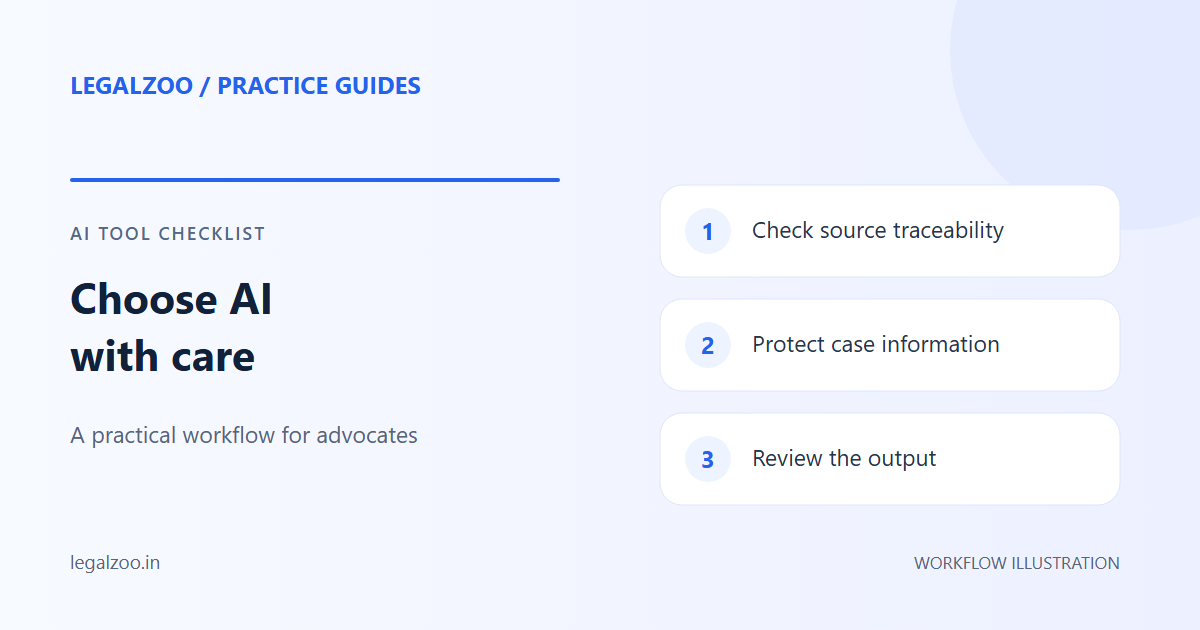
Choose an AI tool for a specific task, test it with a bounded authorized example, and check whether its claims can be traced to reliable source material.
Match the tool to the task
Legal work involves different information needs. A court-status retrieval tool, a document summarizer and an argument-practice system should not be evaluated as if they do the same job.
| Task | What to verify |
|---|---|
| Court status or cause list | Correct matter, official source context and freshness. |
| Document summary | Statements can be traced to the supplied document. |
| Legal research | Authorities exist, say what is claimed and are relevant. |
| Argument practice | Assumptions and missing facts are identifiable. |
| Diary assistance | Proposed entries are reviewed against the court record. |
A confident tone is not evidence of correctness. A useful answer should make verification easier rather than hide uncertainty.
Run a small comparison
Use a short, authorized example whose contents you already understand. Ask each candidate tool the same bounded question. Compare errors, missing qualifications, source references and the effort required to correct the result.
Check current pricing, document limits and privacy terms directly with the provider. This LegalZoo-published guide is not an independent top-five ranking and makes no unsupported claims about competing products.
Keep court information authoritative
Use eCourts Services and the Delhi High Court website as relevant starting points for official court information. An AI summary should not replace an order or turn an unavailable cause list into an assumed adjournment.
LegalZoo combines case organization with supporting tools, but their outputs have different meanings: a saved court PDF, a dated retrieval and an AI practice response should remain clearly distinguishable.
Read the AI argument-practice guide for a bounded preparation workflow and the software evaluation checklist for chamber-wide testing.